What a Difference a Week Makes!
Our third and fourth weeks of surveys were a study in contrast. The week of Jan 19 brought a tornado warning, cold weather advisories, and strong sustained winds from the north. Aerial survey teams from South Carolina to Florida were grounded, and we cancelled our shore-based surveys (although some intrepid souls scanned the waters from time to time). On Saturday Jan 25, as the seas began to settle, our volunteers mounted full lookouts and FWC’s plane surveyed as far north as St. Simons Island, GA. No mother-calf pairs were spotted.
Sunday Jan 26 heralded a stretch of warm weather and calm seas. It didn't take long for the phone to start ringing! At 8:45 am, Team 2 Sunday called from the Marineland boardwalk with their team's first ever whale sighting: two whales with V-shaped blows, heading south! Sara verified the sighting, notified leaders of nearby community teams at Surf Club, Cinnamon Beach, and Hammock Dunes, and called all our drone pilots.
Members of Team 2 Sunday were thrilled to spot right whales off the boardwalk of Marineland, FL on Jan 26. Image: Sara Ellis.
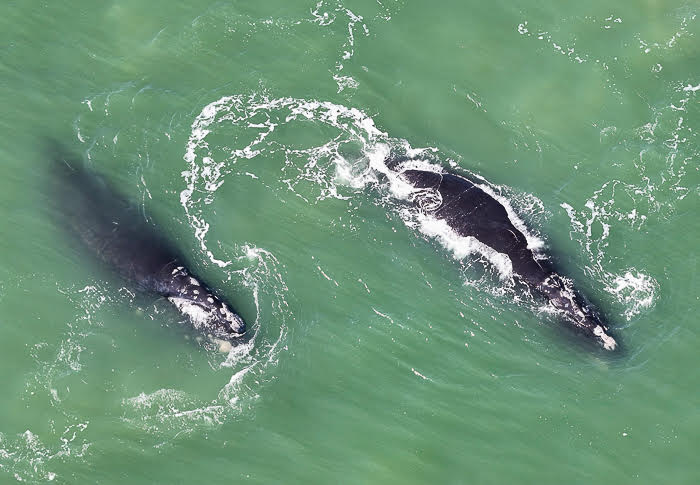
Groups of volunteers started leapfrogging down the coast, following the whales to Bay Drive Park, in Palm Coast. Jeff Greene was able to get drone photos of this mother-calf pair and FWC quickly identified the mom as #3705, Check Mark. She is the seventh mother of the season, first sighted by FWC on Jan 17. She is 18 years old with her 1st known calf.
Carol Logan captured additional photos and videos via drone while others took photos from land. The whales were staying close to shore as they continued southward, so we sent out the first RoboCall of the season. Throughout the day, many volunteers watched this pair and kept us apprised of their locations.
Check Mark & calf, off Palm Coast, FL on Jan 26. Image: Jeff Greene, NMFS Permit #26562.
The next day, at 10:45 am, Team 3 Monday spotted a pair of whales near the horizon, north of the Flagler pier, heading south. They were too far offshore to be reached by drone, and FWC’s plane was further north, so there was no chance of immediate identification; we guessed it was the same whales seen the day before.
The team kept their eyes on the pair and at 1:30pm, Russ Hatfield texted to say the whales were much closer now--maybe within drone range. Conveniently, Sara, Lorraine, and Sector 3 co-leaders John & Linda Wilson were having a snack at the Golden Lion restaurant and now could see the whales from there! They headed to the nearest beach walkover and called in the program’s newest drone pilot, Michelle Ross, who lives close by.
As Sara flew her drone and examined the mother’s callosities, she realized it was NOT Check Mark. She noticed odd coloration on the mother’s right flank and saw old propeller scars. It was Caterpillar (#3503), so named for the large caterpillar-shaped scar she received from a vessel strike when she was two years old. Caterpillar is the 4th of the seven moms spotted so far this season. She is now 20 years old and this is her 1st known calf.
After Sara sent ID photos to FWC and sent out a RoboCall, Michelle took advantage of the calm conditions and slow-moving whales to fly her drone with Sara’s guidance. As the watch day went on, more volunteers and members of the public got to observe these whales from shore. Drone pilots Jeff Greene and Jack Dewhurst took additional photos and video.
Caterpillar & calf, off Flagler Beach, FL on Jan 27. Image: Jack Dewhurst, NMFS Permit #26562.
FWC’s aerial team flew down to Flagler Beach. In addition to photo-documenting Caterpillar, they spotted Check Mark & calf, as well Black Heart & calf, 5 and 6 miles off Marineland. Also, Julie Albert received photos from a member of the public of Nauset & her calf just north of Cape Canaveral on Jan 26. All told, there were four mother-calf pairs spotted over these two days!
Before the cold windy streak, the seven mother-calf pairs were being sighted fairly regularly near--or north of--the Florida/Georgia border. After the winds abated, four of these pairs were spotted between Marineland and Cape Canaveral. Had the calves been pushed southward by prevailing winds? Or did the mothers travel south purposefully, in search of warmer water? Further inquiry may help answer such questions.
Mid-Season Meeting
Our mid-season meeting is fast approaching. It will be held Saturday, Feb 8, from 1:30 to 4:00, at the Whitney Laboratory for Marine Bioscience, 9505 N Ocean Shore Blvd. St. Augustine, FL 32080. Signage by the road will help direct you to the location. Please carpool if possible.
The first hour will be for social time. This will be a “light” pot-luck event. Please bring finger food or desserts. We will provide coffee, beverages, plates, and utensils… and door prizes. You can pick up your pre-ordered merchandise and there will be some extra items for spontaneous purchases (cash, check, or credit).
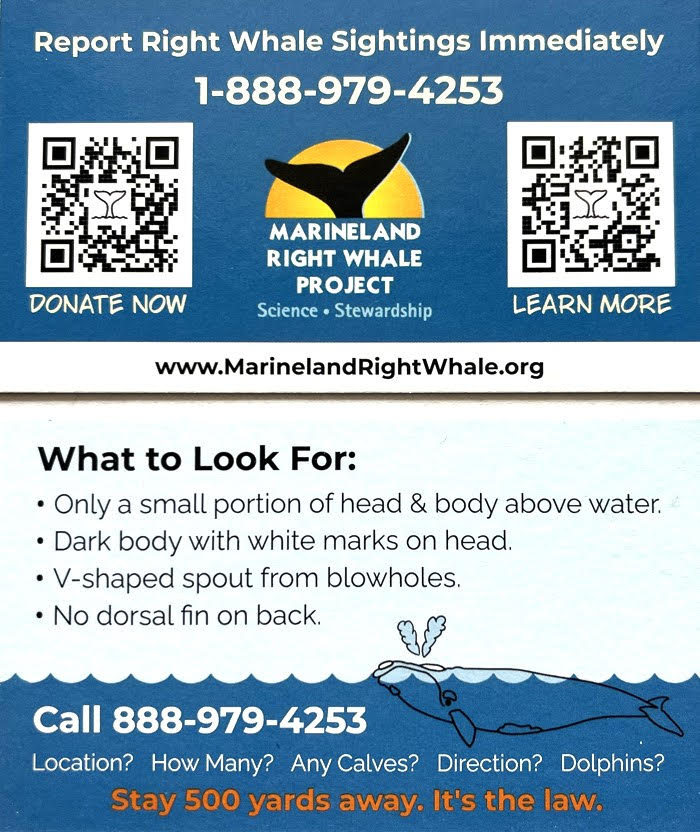
At 2:30 we’ll move into the auditorium, and pick the lucky winners of the door prizes. Sara will give updates on the current survey season, an overview of research & conservation technologies, and—drum roll please—an introduction to our program’s new website and sighting cards!
Join us for fun, food, and updates.
In the meantime, here’s hoping for more whale sightings in our survey area!
Sara and Jim